Black Redstart

Black Redstart
(Phoenicurus ochruros)1 - 3 of 3 Photos

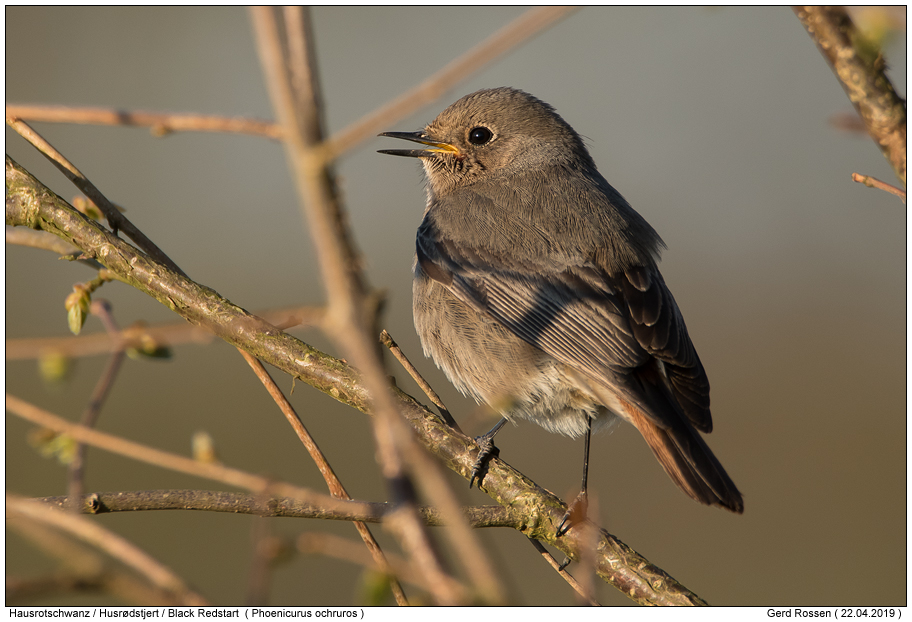
Female Black Redstart

Juvenile Black Redstart

Black Redstart
Black Redstart (Phoenicurus ochruros)
|
Family :
Flycatcher ( Muscicapidae ) Typical Characteristics : The Black Redstart  is a small, slim songbird, about 13–15 cm (5–6 inches) long with a wingspan of around 23–26 cm. A key feature is the reddish-orange tail, which is often flicked. is a small, slim songbird, about 13–15 cm (5–6 inches) long with a wingspan of around 23–26 cm. A key feature is the reddish-orange tail, which is often flicked.Adult males are mostly dark grey to black with a black face and chest and a grey back. Females are more grey-brown overall, with less contrast and a paler red tail. Juveniles resemble females but are more mottled. These clear differences make the sexes relatively easy to distinguish. Behaviour : The Black Redstart is generally solitary or found in pairs, especially during the breeding season. Males are territorial and actively defend their breeding area against rivals. A characteristic behavior is its frequent tail-flicking and tail-shaking, often showing the red tail.Outside the breeding season, Black Redstarts may tolerate other individuals and can sometimes be seen loosely associating in small groups, especially at good feeding sites. They are alert, active birds and often perch openly on rooftops, rocks, or fences while watching for prey.Food : The Black Redstart mainly feeds on insects and other small invertebrates, such as beetles, flies, spiders, ants, and caterpillars. During autumn and winter, it may also eat small berries and seeds. It usually searches for food on the ground or catches insects in short flights.
|
Reproduction Or Breeding :
Black Redstarts are usually monogamous during the breeding season. The male defends a territory and attracts the female with song and display. They often raise one or two broods per year.The female typically lays 4–6 eggs per clutch. They nest in rock crevices, buildings, walls, roofs, or other cavities, often close to human settlements. The nest is built mainly by the female and is well hidden. Habitats, Locations : The Black Redstart is widespread across Europe, parts of North Africa, and Central Asia. Some populations are resident, while others migrate south to southern Europe, the Mediterranean region, and North Africa during winter.It prefers rocky areas, mountains, cliffs, and open landscapes , but it has adapted very well to urban environments. Typical habitats include villages, towns, industrial areas, ruins, and buildings, especially where there are ledges and cavities for nesting.Special Notes : |
Copyrights
All photographs, graphics and written text published on this domain and all its subdomains
are copyrighted by Gerd Rossen.
Reproduction or use in any manner without
the authors permission is prohibited.
Problems with Javascript or PopUp-Windows
If you have no ability to view Pop Up windows you can alternatively view the additional text/description to the pictures and catchwords for the internal search given to the pics by the photographer when uploaded as well as the camera equipment used to photograph here.
If you can't view the Full Size Pictures above, cause JavaScript is not enabled in your browser (often in schools and public places), you can view the full sized pics by clicking at the Thumbnails below :
|
"Female Black Redstart" : Photo Black Redstart! Sorry - Information Not Available - Catchwords given by the Photographer : Vogel Vögel Bird Birds Singvogel Singvögel Songbird Songbirds Rotschwanz Hausrotschwanz Hausrotschwänze Black Redstart Husrødstjert Phoenicurus ochruros Aves Weibchen Hausrotschwanzweibchen weiblicher Black Redstart-photo description info Black Redstart characteristics Black Redstarts Phoenicurus ochruros Black Redstarts-photosPhotographer : Gerd Rossen Digital camera used : Nikon D5500 + Tamron SP 150-600mm F/5-6,3 Di VC USD Focal Length : 550mm Resolution of the Photo : 3574x2383 Pixel |

|
"Juvenile Black Redstart" : Picture Black Redstart! Juvenile Black Redstart photographed in Vogelsang, Nordeifel, Germany. - Catchwords given by the Photographer : Vogel Vögel Sinfgvogel Singvögel Bird Birds Songbird Songbirds Rotschwanz Rotschwänze Hausrotschwanz Hausrotschwänze Black Redstart Black Redstarts encyclopaedia voegel Black Redstart-pic information Black Redstarts-photo infoPhotographer : Gerd Rossen Digital camera used : Canon EOS 20D + Canon Extender EF 2x II + Canon EF 400mm 2,8 L IS USM Resolution of the Photo : 3084x2056 Pixel |

|
"Black Redstart" : Photos Black Redstart! Sorry - Information Not Available - Catchwords given by the Photographer : Vogel Vögel Bird Birds Singvogel Singvögel Songbird Songbirds Hausrotschwanz Hausrotschwänze Rotschwanz Rotschwänze Black Redstart Black Redstarts Black Redstarts-pics Information Black Redstart-pics. Black Redstarts-picturePhotographer : Gerd Rossen Digital camera used : Canon EOS 20D + Canon Extender EF 2x II + Canon EF 400mm 2,8 L IS USM Resolution of the Photo : 2960x1973 Pixel |


Quick Menu
New Galleries :
New Galleries :
- Siberian Tits
- Eurasian Woodcock
- Flower Crab Spider
- Pine Grosbeak
- Spiny Puffball
- Scarlet Elf Cap
- Roundhead (S.squamosa)
- Elfin Saddle
- Ballpen
- Flagpoles and Flags
- Alder Moth